
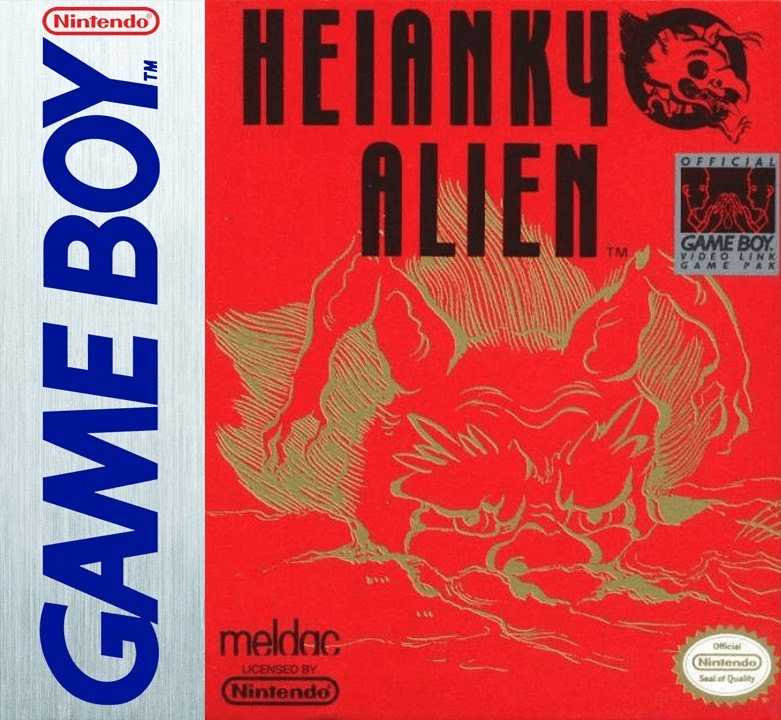
It takes an enviable amount of confidence to call a game “THE JAPANESE MASTERPIECE” on your print ads, but Meldac had it like that back in the 90s. You don’t localize a game like Zombie Nation without being totally convinced it’s a good idea, and they were absolutely right to do so. Everyone say “Thank you, Meldac”.
The history of Heiankyo Alien is as interesting as it is lengthy, a consequence of its original design emerging in the late 70s from a team at the University of Tokyo’s Theoretical Science division. That version is included on this cart as a bonus for the ludologically curious! It’s…definitely a game from the 70s that isn’t Space Invaders, but it represents a niche within a niche and predates the likes of Pac-Man by a year, so that’s neat.
What immediately struck me was the sheer amount of personality contained in the new game’s rendition. The sprites are goofy and expressive, the movement is snappy, and the music, my god. HA has some of the best jams found on the system, combining traditional Japanese instrumentation in bloop-heavy Game Boy form with a modern edge that suits the retro-sci-fi-ness of the whole affair. Just phenomenal music to dig holes to.
Oh yeah, that’s what this game is about! Aliens have descended in Heian era Japan and are scarfing down people in the streets. For whatever reason our little Kebiishi is only armed with a shovel, but he’s about to make it every alien’s problem. Gameplay sees you running through various mazes, digging holes, then burying aliens alive when they stumble into them. Any contact with them will see you devoured whole! The sprites for this are kinda fucked for the Game Boy, honestly! I guarantee at least a couple children had Heiankyo Alien Nightmares. God that’d make a good album name.
So you’re playing a game of territory control. Your first order of business on any given board is to establish a safe zone that’ll prevent an ambush, then gradually expand it by filling and digging new holes further out, shifting from defense to offense as you gradually thin the aliens’ numbers. Placement of holes is critical as aliens won’t stay in them forever, and if another alien runs into a partially-buried pal they’ll immediately free them, which can see you getting chomped from what appeared to be a position of strength. Combine this with the alien movement behaviors being kinda random until the last one, who will immediately speed up and chase you to the ends of the screen, and you’ve got a game state that’s always comprehensible but never solved.
Outside of a few environmental quirks like walls that open and shut or a boat you can scoot across sections of the level with later on, that really is all the rules to Heiankyo Alien. Yet from this simple foundation is built a game that I find fiendishly moreish. Approachable, moderately challenging, a bit lucky but always achievable, just perfectly calibrated arcade action. I’ve cleared this thing several times now – not an extraordinary feat, it’s pretty short – and my best run thus far saw me only losing 1 life. I want, no, need to perfect this thing eventually. I’ve got the alien brainworms and they can have all the gray matter they want.
Transparently, Heiankyo Alien was going to top the current list no matter what. I’ve got a backlog of completed games to write about and keep trying to plug away at more, but unlike literally every other game I’ve played for this project I keep going back for more rounds of this instead, and that’s the strongest endorsement I could give. I’m not always gripped by arcade style games on console as they often lose something for the lack of quarters, joysticks, and secondhand smoke, but Heiankyo Alien fully transcends all of my preexisting hangups. It grips me in the kind of way only the best arcade games can, perfectly aligned with my brain chemistry, and I couldn’t be happier to give it its flowers 25 years later.
That’s essentially the complete writeup. My original intent was to give this just shy of a perfect score given how slight its scope and completion time is, even though what’s on offer is excellent. Can I tell you what bumped this up to full marks, though?
I traveled across the country to visit family recently, and was fortunate to get to spend a few days with my nephews and niece that are really little and love video games. If they aren’t playing some sort of big Nintendo release in the living room, they’re on their tablets playing games that even their parents have described as brain rot. At one point, after they expressed interest in the funny brick I was traveling with, I handed them my Game Boy with Heiankyo Alien ready to go and let them take turns figuring it out with minimal guidance.
They were fascinated. It gripped them like most games don’t. They were actively experimenting, giving each other pointers on where to dig, how to dodge aliens, trying to predict their behaviors, and getting eaten over and over until bedtime. No ad break interruptions to earn resources, no connectivity issues, no distractions, only pure unleaded video game. They were so engaged that they even managed to share without fighting the entire time! That’s a small miracle!
There’s just something about Heiankyo Alien that works on a level most games don’t, a true It factor, and for me that overcomes any complaint I could level at it. Heiankyo Alien forever.

 Wack Game Boy Zone