Tag: retro

  • Feed IT Souls: DOME Edition (2025)

    Feed IT Souls: DOME Edition (2025)

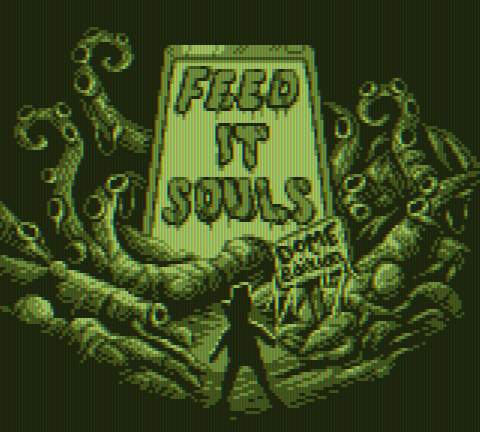
    Feed IT Souls is an angry game. I suspect it wouldn’t exist without that anger. This game is its opinion on its subject matter, fully entangled and intertwined, and it hates that subject. If you’re reading a blog about indie, artist-made Game Boy games in current year, you’ll probably find something to agree with here. I have thoughts on those thoughts, and will elaborate on them in a minute, but I’d be doing FIS a disservice if I didn’t talk about it as a video game as well, because it’s pretty good at being one!

    This is a platformer, and as such you have a jump. Said jump lasts about exactly as long as you hold the button until you hit its apex, meaning movement feels responsive, weighty, and most importantly, precise. The levels take this precision into account, demanding accuracy or a trip back to the last checkpoint, but never becoming so challenging that it feels unreasonable thanks to the quality of the player control.

    FIS is technically a metroidvania, albeit a considerably distilled one, and as a result you gain some movement tricks over the course of the game. I typically dread when platformers grant significant midair controls as the level design and challenge tends to suffer as a result. You’ll be spared from me complaining about double jumps and their consequences today, because FIS’s execution of aerial movement is better than most. The dash here combines movement with offensive utility in a far more satisfying manner than many comparable games, maintaining the game’s pace and precision, without ever feeling like it’s trying to fit too many functions onto the Game Boy’s layout. It’s satisfying! I’d have liked to see a few more hazards, as well as some more challenges (optional or otherwise) that really squeezed this moveset for everything it had, but I’m willing to chalk this up more to my enjoying the gameplay enough to want more of it than any failure of design.

    A playthrough of FIS will probably take most folks about an hour or so. I played carelessly, and spent a bit of extra time slithering in and out of the game’s many wall-vulvas at the end to grab the 3 eggs I missed for 100%, so I spent more time in the grime. I was never bored for a moment, and it opts to wrap up just before its ideas would start running out of steam. Let me reiterate though, you’re just as much here for this game’s ideas and catharsis as you are the hop’n’bop if not more so, and as a result this brisk pace only serves to strengthen what’s on offer.

    Alright, that’s the video game addressed! Now I get to call Elon Musk a loser on a website that talks about Game Boy games and have it actually be relevant! What a time to be alive.

    So yeah, that’s what this game is about. If you consider that a spoiler I apologize, but it has a bigass muskrat enemy as well as a ton of direct references to the man and his ceaseless posting pretty early in, so I don’t think I’m ruining anything by saying so. If anything I suspect a lot of folks would be a lot more interested in the game’s pitch if it just came right out and said it on the itch.io pa-oh wait, it does! It says anti-Musk right there! And people on the internet manage to be surprised or confused as to what this is trying to do? I get we’re here to play Game Boy games, but there isn’t even subtext! Come on y’all.

    Anyway! I think we’ve all earned a bit of Musk-bashing as a treat after being subjected to years of his dogshit opinions and suffering his continuous direct impact on our actual real lives. This game doesn’t even alter his actual words that much beyond recontextutalizing them for the MeatMars we find ourselves on. He’s just as petulant, idiotic, and pissy here as the real thing, ruining the lives of everyone around him in service of seeing his vision through, only to constantly change that vision when the realities of the situation prove it untenable then declare victory by super-genius anyway. With every shove of the goalposts more lives and skilled workers are lost, until the situation deteriorates to the point where he needs to upload his consciousness to a comically oversized smartphone and manufacture more help. Now your player character is the newest helping hand fresh off the conveyor belt, built to serve, unquestioning, lest you be thrown back in the meatgrinder and replaced with another. The greatest sin you commit in the eyes of your “creator” is reclaiming your agency. Apt!

    Look, I’m a writer. I like a clever work that I need to unpack as much as the next person who was failed by a public school gifted program. Subtlety can be useful, but it is but one tool of many in a writer’s belt, and sometimes it’s the wrong tool for the job. Sometimes precision instruments don’t get it done. Sometimes you just need a hammer. Feed IT Souls is a pneumatic one. I can’t call this the greatest Game Boy game I’ve played, indie or otherwise, but I’d be lying if I said I didn’t enjoy it from head to tail, both as a platformer and as a platform.
    4/5

  • Tennis (1989)

    Tennis (1989)

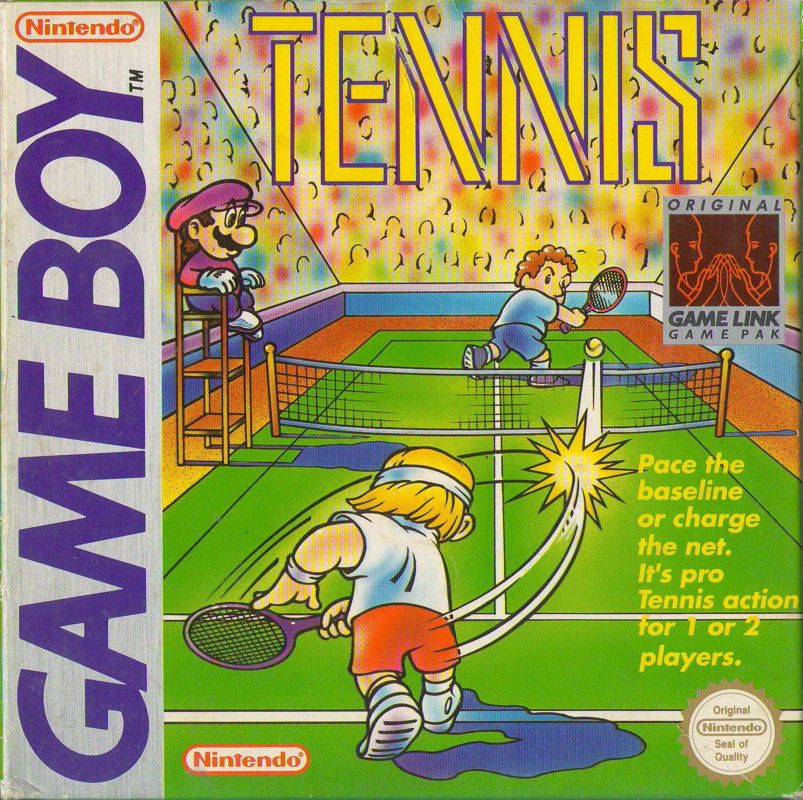
    Mario” Tennis? We’ve already got that game at home! See, there’s Mario! He’s the one who keeps telling you how bad you are at serving!

    Consider that this was a Game Boy launch title, on a system that was a lot of people’s first exposure to Nintendo and its roster of marketable mascots. I would love to meet the person whose response to “Hey, do you like Mario?” would be “Who, the Tennis judge?”. He’s so out of place too, just sittin’ there watching completely normal dudes whack the ball around, surrounded by an audience of more normal dudes. If it wasn’t for the cutaways to his smiling face every time you foul, I’d have thought it was just an overt easter egg or something, but no! They want you to know that Mario is Here. Watching. Waiting.

    Beyond the ever present plumber, yeah this sure is a Tennis game. A hits fast but risks clipping the net, B lobs and travels slower. Your dpad input influences your shots and gives you a surprising amount of control, and it doesn’t do you the kindness of Mario Tennis when it comes to hitting the ball well outside of the lines. I initially chafed at Mario constantly telling me that the very-obviously-on-the-line balls weren’t, but grew to appreciate the amount of finesse this game’s hitting has. Makes for good multiplayer too!

    Where I have some gripes is the character movement. It, uh, sucks. You’re slow as hell, there’s no lunges or dives or anything, only waddle around and smack. It makes playing the net feel incredibly risky as you can position the ball better, but any wide lob will kill you dead without recourse. The game has 4 levels of difficulty as well, each making your opponent faster and boosting the ball speed, meaning the game becomes entirely about positioning.

    Actually, let’s talk about that speed for a second. Tennis goes fast as hell by levels 3 and 4. Where was this in Baseball? That game felt like you were playing in the vacuum of space, meanwhile Tennis had me gripping my GB a little too tightly as I rocked the pad back and forth rapidly, scrambling to keep the ball in play against a much stronger opponent. On level 4 it was almost more Ping Pong than Tennis and I consider that a feature. When you take the game on its terms and allow yourself to just play, Tennis manages to capture all of the intensity of actual matches surprisingly well despite, or in part because of, its simplicity. It’s just you, your opponent, and the ball. Oh, and Mario. Mario is there. Mario is always there.

    So is this as good as Mario Tennis, a game that came out over a decade later? Hahahaha, no! God no! That said, the more I played Tennis the more I came to enjoy it. Sure the movement is stiff, but the ball control and sheer speed is enough to make me appreciate it on its own merits. Turns out this “Nintendo” company actually can make a sports game! You love to see it, and I don’t mean the tennis score definition.

    3/5

  • Catrap (1990)

    Catrap (1990)

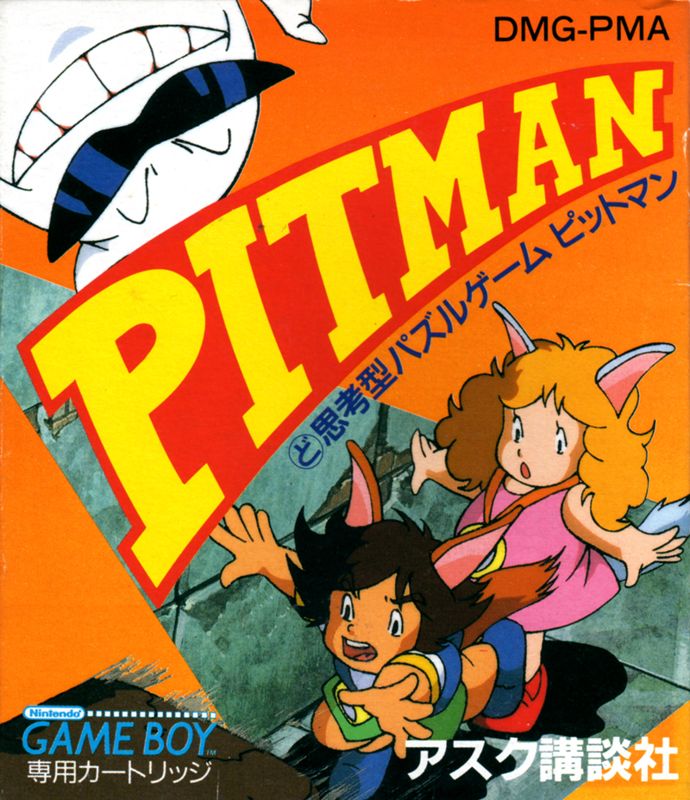
    Let’s start with the obvious – why the Japanese cover this time? Because for whatever reason that’s the version of the cart that I own! Near as I can tell they’re identical beyond the title – the game is as language independent as it gets. Truly box pushing has no borders.

    Anyway, Catrap! The history of this one is similar to several other GB puzzle games, which is to say it’s a Game Boy port of a preexisting computer game made by another studio. The premise is, uh, weird! Our heroes (named Catboy and Catgirl) are minding their own business when they’re suddenly turned into cat people. Which means their names were just…that? Already? Regardless, our heroes are so motivated to de-cat themselves that they beat the everloving shit out of several Spirit Halloweens’ worth of spookingtons to do it. Somehow that solves the problem! Fuck yeah! Violence wins!

    The Sokoban comparison is obvious and certainly not invalid, but Catrap feels meaningfully distinct for several reasons. It’s got gravity, for one! You still move and push on a grid but its levels resemble a platformer, only you can’t jump. The vast majority of the puzzles involve finding ways to push and drop boxes into the right spots so you can bump into an enemy, at which point you’ll sock their lights out with an animation I never got tired of. Beat down all the baddies in the level and you win! Simple as.

    By far this game’s most standout design feature is its phenomenal undo/redo function. Since all you need to play is a dpad, A and B are committed to undoing as many steps as you’d like and redoing just as many if you rewound too far. I cannot adequately emphasize how much better the experience of solving these puzzles is made for this inclusion. I’m very much an experimenter, someone who likes to visualize by touching the thing, which older Sokoban games typically punish by forcing a full restart. You may recall that Boxxle, cursed be its name, only allowed you to take a whole 1 step back! Catrap is almost shockingly generous for a game of its era, providing considerable quality of life without compromising its challenge in any way. It predates a lot of other time-rewind-type games, yet I’d argue Catrap handles it better than several far newer titles!

    I haven’t even gotten to some of the game’s more ambitious qualities! A bunch of levels feature both characters and have you switch which one you’re controlling, effectively turning the other one into a block (and also swapping between their two different music tracks, which is a nice touch). There are a lot of creative uses for this freeze’n’swap and I found those puzzles to be by far the trickiest to get my head around. It also has an entire level editor, and the manual goes so far as to include codes for even more than the base 100 if you just can’t get enough ghostbusting. That’s a lot of game for your 90’s dollar, especially this early in the console’s life!

    Turns out I am absolutely down to shove boxes for 100 levels if my time is respected and I get to concuss a mummy. I cannot adequately explain nor justify why the objective being “I want to punch that ghost in its stupid face” motivated me so much more strongly than box reorganization. Maybe that’s explanation enough? Regardless, this is a welcome deviation from traditional Sokoban while still offering the same level of satisfaction you’d expect from its crunchy 100-step puzzles, and it’s aged like a fine catwine. If this never came out back in the day and dropped on Itch.io tomorrow the puzzle sickos would still be feasting.

    4/5

  • Dexterity (1990)

    Dexterity (1990)

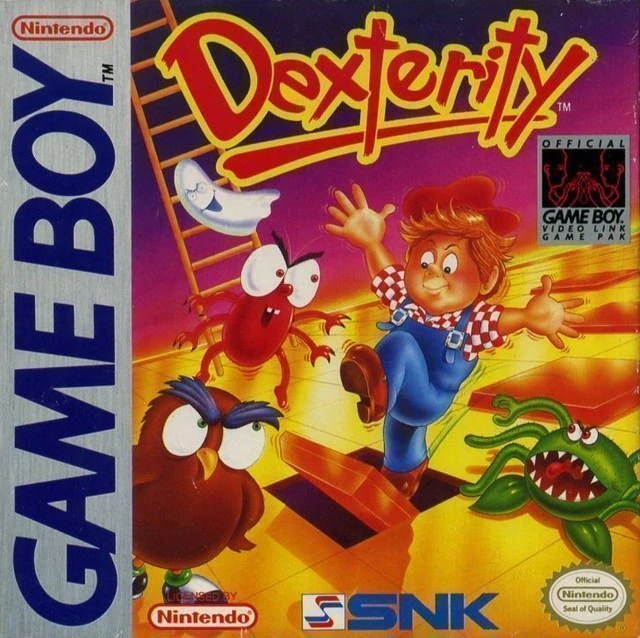
    In the How to Play section of Dexterity’s manual SNK calls this a “jigsaw puzzle, maze, and labyrinth game“. That’s a pretty unhelpful description, so I’ll give you mine: Dexterity is a Fucker Game. For the unfamiliar, FUCKER GAME, DEFINED: “a game that involuntarily makes you call it a Fucker frequently and with increasing intensity.” Alumni of Fucker Game University are not necessarily bad, but they are typically frustrating, obnoxious, or both. Dexterity just happens to be all of the above! FGU! FGU!

    I would love to tell you what Dexterity is about, but SNK didn’t manage to figure that out before manufacturing the cart labels. In Japan it was called “Funny Field” which still doesn’t explain why this little boy is trapped in a series of increasingly horrible grids. The manual’s story page ends on “So find the magical key to unlock the door to not only Dexter’s but your own wonderful imagination!”. I tried, but a beetle sat on the key until I died of exposure.

    The goal of the game is to flip all the floor tiles to their other color before the timer runs out. This works similarly to Reversi, by which I mean if you flip a tile and there’s another flipped tile in the same row or column, it’ll flip every tile in-between to the same color. Please don’t get the impression that this is a cerebral, abstract affair. The game’s called Dexterity, y’know? It isn’t as much of a puzzle game as it is a real time scramble with enemies that’ll unflip your tiles, forcing you to double back to fix them. At first this is fairly simple to the point of being a bit dull, but eventually the stages transition to a particularly shitty maze game filled with enemies that hate the board, hate you, but most of all, hate predictable behavior.

    Games like this always involve variance but Dexterity’s luck factor is way out of whack. Enemies may or may not bother to flip tiles in any given direction or at any given time. Their movement styles are predictable in that some are slow, some are fast, some tend to turn, etc., but what they actually do is known only to them and god. If I voiced my opinion of that goddamn snowman I would get in trouble. This is exacerbated by the powerups. These range from giving you a few worthless points to all but winning you the level, but what you get is mostly random as far as I can tell, beyond the good ones being rarer. Because of course they are. Most of the time you’re playing from behind, trying to play Reversi uphill despite Wesley Snipes’ warnings, but it’s just as unsatisfying when the game occasionally just throws you a win for free!

    I was so convinced that this game was fucking with me that I swapped to a save state-capable device and started testing. Some of the enemies pretty much always do the same thing, and you can semi-reliably route some sections, but as I reran annoying levels again and again I noticed irregularities. Sometimes the enemies did practically nothing, other times they would go so far as to hold chokepoints and just refuse to move, wasting upwards of 10 seconds or getting me killed outright. Success isn’t earned in Dexterity, it’s eventually granted.

    Even the bonus game is borderline random! At first it looks like it’s just a memorization challenge, flashing a bunch of tiles on an otherwise empty board that you need to remember and flip, except one of them is secretly a skull that’ll kick you out with no extra life to your name. I think these patterns are preset and if you memorize the placements you’ll be able to 100% them, but that’s a level of time-sadism I simply do not possess, says the guy who’s playing all of these.

    By the time you manage to hold onto your continues long enough to get to the end you’re confronted by King Tojo, a bigass ghost boss who’s basically from a different video game with mechanics to match. The fight involves picking up and throwing enemies, a mechanic that doesn’t exist until then, meaning if you don’t immediately get the hang of it and successfully land the dozen or however many hits Tojo demands there’s a very real chance you have to play the entire video game over again. Did you know this game’s Nintendo-assigned designation is DMG-FU-USA? You cannot make this shit up! They know what they did!

    I like the jaunty little tunes. I guess. Half a point for those. Fucker.

    1.5/5

  • Heiankyo Alien (1990)

    Heiankyo Alien (1990)

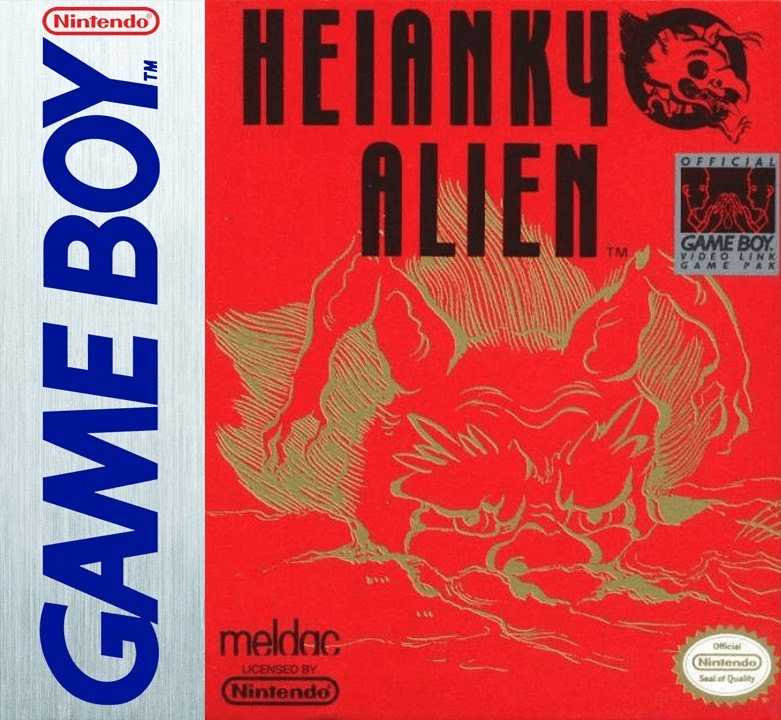
    It takes an enviable amount of confidence to call a game “THE JAPANESE MASTERPIECE” on your print ads, but Meldac had it like that back in the 90s. You don’t localize a game like Zombie Nation without being totally convinced it’s a good idea, and they were absolutely right to do so. Everyone say “Thank you, Meldac”.

    The history of Heiankyo Alien is as interesting as it is lengthy, a consequence of its original design emerging in the late 70s from a team at the University of Tokyo’s Theoretical Science division. That version is included on this cart as a bonus for the ludologically curious! It’s…definitely a game from the 70s that isn’t Space Invaders, but it represents a niche within a niche and predates the likes of Pac-Man by a year, so that’s neat.

    What immediately struck me was the sheer amount of personality contained in the new game’s rendition. The sprites are goofy and expressive, the movement is snappy, and the music, my god. HA has some of the best jams found on the system, combining traditional Japanese instrumentation in bloop-heavy Game Boy form with a modern edge that suits the retro-sci-fi-ness of the whole affair. Just phenomenal music to dig holes to.

    Oh yeah, that’s what this game is about! Aliens have descended in Heian era Japan and are scarfing down people in the streets. For whatever reason our little Kebiishi is only armed with a shovel, but he’s about to make it every alien’s problem. Gameplay sees you running through various mazes, digging holes, then burying aliens alive when they stumble into them. Any contact with them will see you devoured whole! The sprites for this are kinda fucked for the Game Boy, honestly! I guarantee at least a couple children had Heiankyo Alien Nightmares. God that’d make a good album name.

    So you’re playing a game of territory control. Your first order of business on any given board is to establish a safe zone that’ll prevent an ambush, then gradually expand it by filling and digging new holes further out, shifting from defense to offense as you gradually thin the aliens’ numbers. Placement of holes is critical as aliens won’t stay in them forever, and if another alien runs into a partially-buried pal they’ll immediately free them, which can see you getting chomped from what appeared to be a position of strength. Combine this with the alien movement behaviors being kinda random until the last one, who will immediately speed up and chase you to the ends of the screen, and you’ve got a game state that’s always comprehensible but never solved.

    Outside of a few environmental quirks like walls that open and shut or a boat you can scoot across sections of the level with later on, that really is all the rules to Heiankyo Alien. Yet from this simple foundation is built a game that I find fiendishly moreish. Approachable, moderately challenging, a bit lucky but always achievable, just perfectly calibrated arcade action. I’ve cleared this thing several times now – not an extraordinary feat, it’s pretty short – and my best run thus far saw me only losing 1 life. I want, no, need to perfect this thing eventually. I’ve got the alien brainworms and they can have all the gray matter they want.

    Transparently, Heiankyo Alien was going to top the current list no matter what. I’ve got a backlog of completed games to write about and keep trying to plug away at more, but unlike literally every other game I’ve played for this project I keep going back for more rounds of this instead, and that’s the strongest endorsement I could give. I’m not always gripped by arcade style games on console as they often lose something for the lack of quarters, joysticks, and secondhand smoke, but Heiankyo Alien fully transcends all of my preexisting hangups. It grips me in the kind of way only the best arcade games can, perfectly aligned with my brain chemistry, and I couldn’t be happier to give it its flowers 25 years later.

    That’s essentially the complete writeup. My original intent was to give this just shy of a perfect score given how slight its scope and completion time is, even though what’s on offer is excellent. Can I tell you what bumped this up to full marks, though?

    I traveled across the country to visit family recently, and was fortunate to get to spend a few days with my nephews and niece that are really little and love video games. If they aren’t playing some sort of big Nintendo release in the living room, they’re on their tablets playing games that even their parents have described as brain rot. At one point, after they expressed interest in the funny brick I was traveling with, I handed them my Game Boy with Heiankyo Alien ready to go and let them take turns figuring it out with minimal guidance.

    They were fascinated. It gripped them like most games don’t. They were actively experimenting, giving each other pointers on where to dig, how to dodge aliens, trying to predict their behaviors, and getting eaten over and over until bedtime. No ad break interruptions to earn resources, no connectivity issues, no distractions, only pure unleaded video game. They were so engaged that they even managed to share without fighting the entire time! That’s a small miracle!

    There’s just something about Heiankyo Alien that works on a level most games don’t, a true It factor, and for me that overcomes any complaint I could level at it. Heiankyo Alien forever.

    5/5