Tag: video games

  • Bases Loaded (1990)

    Bases Loaded (1990)

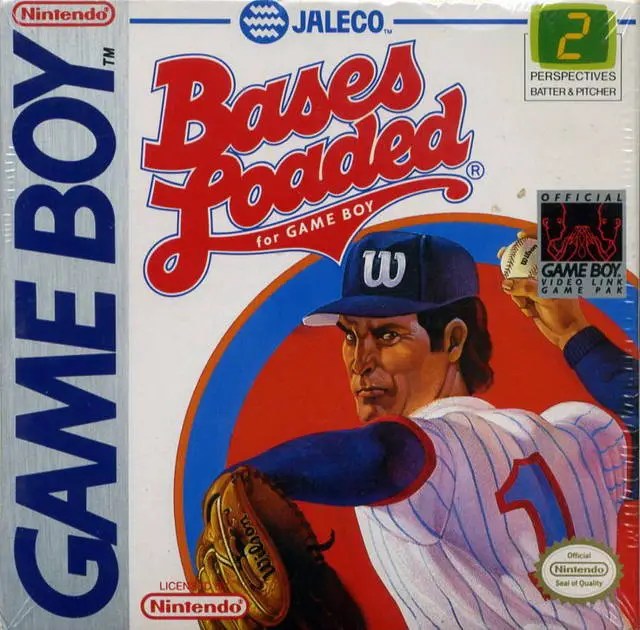
    Wait, it only took a year to make a baseball game that’s this much better than 1989’s Baseball? Are you kidding me? I’m starting to think this “Nintendo” company doesn’t know what they’re doing!

    Bases Loaded was a long-running franchise on the NES, so it stood to reason that Tose (and by extension Jaleco) would want to get a version out quick for their first western release on the Game Boy. America was surely craving quality baseball on the brick at this point, especially after Nintendo struck out the previous year, and Tose delivered exactly that.

    There’s no twist to this writeup. I was genuinely surprised at how well this played! Responsive batting, deeper pitch mechanics where you set the target location then adjust your pitch type, and fielding that doesn’t feel like you’re playing on the moon! Bases Loaded’s big thing was showing the game from the pitcher’s mound rather than the plate and that makes its way into this port too. Later NES games in the franchise went so far as to flip the positioning of the field while on defense, which my muscle memory hates, so I’m glad that’s not what we’re doing here.

    Where this differs from its NES counterpart is mostly the presentation. Lack of color aside, you’d be forgiven for not realizing this was Bases Loaded at all! Players are chibified, though not quite to the extent of a Power Pros bobblehead, and the perspective swaps depending on if you’re batting or pitching. This is peak link cable “each player gets their own screen, we can actually show them what they want to see” gaming for 1990! Sure we lose out on the crunchy voice samples the original game had, but that’s a small price to pay for a game that arguably plays a bit better than its dad!

    There are some funky omissions from the actual sport, most notably not being able to bean a batter with the ball. It just phases through them and counts as a ball! That’s weird! I also didn’t manage to get an infield fly to happen despite intentionally popping a few awful hits entirely on purpose. Quality dingers, though? Very much on the menu. Lofting the ball past the screen’s boundaries and watching the fielders scramble to the wall brings me such joy when it’s done even halfway decently, and BL does it just a bit better than that! You can adjust your swing with up and down, meaning every at bat is an opportunity to hold down and send that ball to the parking lot. There’s even a proper home run celebration! Sure it’s not a blowout, but they tried!

    I may be feeling a bit too generous in the wake of how rough Nintendo’s first party offering was, but I really enjoyed this port of Bases Loaded! It does everything you’d expect a baseball game of this era to do and not an iota more, but does it well. Snatching a stand-bound ball out of the air inches from a child’s hands makes me feel powerful.

    3.5/5

  • Yakuman (1989)

    Yakuman (1989)

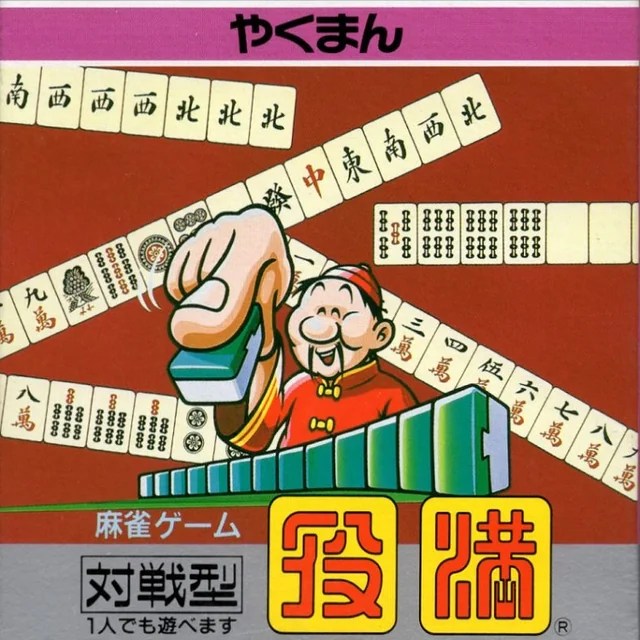
    Oh here we go“, you’re probably thinking. “Western writers always dismiss Mahjong games. Let’s see how he clowns on it. I bet he doesn’t even know what furiten means!

    Guess again, pessimistic reader I’ve invented in my head! I love Mahjong! Especially riichi! Many years ago I learned another variant from an auntie as is tradition, then got into riichi over lockdown and never looked back. I was legitimately excited to try this one as it’s been a minute since I’ve clacked some tiles. How was this implementation?

    Ehhhhhhh.

    Yakuman’s fine. The problem isn’t the quality of the interface, presentation, etc. Honestly it’s all laid out pretty well! Everything’s visible on a single screen and while not having color is a downer it’s manageable, and the inputs are intuitive. The bot opponent makes choices pretty quickly too, which is a rarity for early Game Boy board games! No, the issue is that this is exclusively 2 player Mahjong and that’s just not the best ruleset. I’m not even a diehard 4p or bust kind of guy in matters of Maj’ – I actually love playing with 3! 2p just doesn’t cut it for me most of the time, not without some wacky rule variants, different yaku, something to spice up the I-go-you-go. There are so many better 2p rummy-adjacent options out there!

    Though y’know, I say that now with the benefit of hindsight, but how many competitive options existed in ’89 beyond just playing Gin with an actual real life deck of cards? 2p riichi via a link cable is legitimately a pretty cool use case for the DMG and it certainly beats Nintendo’s previous attempt at standalone virtual Mahjong. I would not be shocked if this killed it among the grandma set in Japan, though I bet the eye strain required to read the characters on the original screen may have scared off more than a few. I appreciate this thing for what it does, even if it’s not all it could have been.

    2.5/5

    Bonus zone because apparently I like to do those when I find extra material – there’s an English translation patch! I didn’t touch it so I can’t vouch for the quality, but there’s very little text in-game so I’d be surprised if it wasn’t sufficient. What it won’t do is teach you Mahjong, but the game already didn’t really do that. Hell, even its manual spends basically no time on the game itself as much as how to operate it. Tile-curious folks will still want to look elsewhere, this one’s for those who are A) already in the know and B) current year Game Boy enthusiasts. Pretty narrow venn diagram, but know that if you fall into it that we are kindred.

  • Boxxle (1989)

    Boxxle (1989)

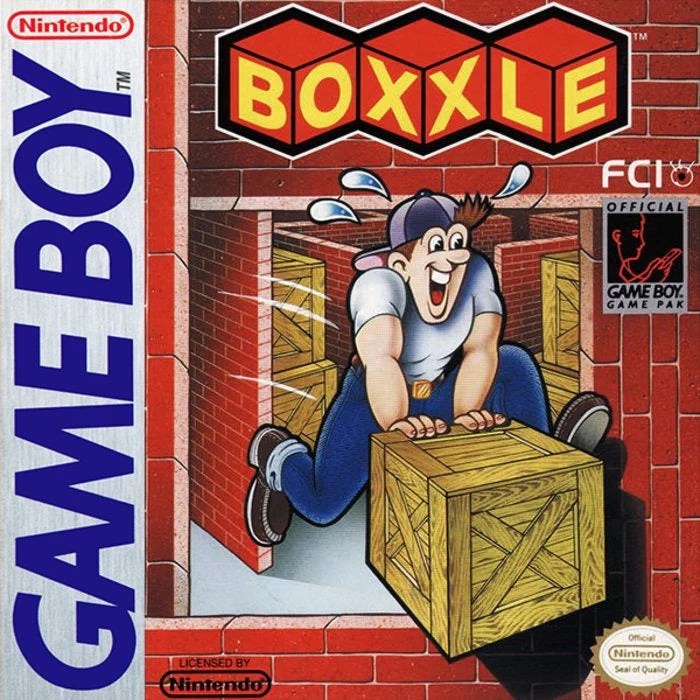
    Can we address the homunculus in the room first? I hate looking at the cover of Boxxle so much it’s unreal. No one has ever been so face-warpingly overjoyed to be pushing boxes. Blink twice if you’re being exploited, man!

    It is time to introduce The Sokoban Clause. The Game Boy’s library is chock full of these damn things, especially early in its life, and I have a horrible Sokoban allergy that’ll see me breaking out in hives if I play them for too long. That’s not to say I’m incapable of enjoying it or its offshoots (as we’ll see in later entries), but I generally prefer it as part of a larger design as opposed to pure unadulterated crate pushing. Going forward, massive Sokoban collections like this are going to necessitate some degree of level skippery, generally by way of passwords. I still intend to beat most of any given crate-shover for the purpose of thoroughness, but I can only shove so much crate before the splinters make it hard to type.

    And boy, Boxxle really offers nothing else to enjoy beyond manual labor. Aside from the cute little arcade game-esque interludes every 10 levels there are no ideas beyond “get back to work, asshole”. You don’t push different boxes. The levels are never anything but brick warehouses filled with wooden crates – the literal only thing that might surprise you is how the game zooms out to a smaller sprite set for big levels so you can still see the entire board. There are no obstacles beyond walls. It’s the same thing 108 times. The background music never even changes from the same 26 second loop! Yes it’s a whole 26 seconds, I counted. Because I had nothing else to think about.

    There are some considerations taken that make Boxxle marginally more tolerable than earlier Sokoban riffs. Restarts are quick. There is technically an undo button, though don’t give them too much credit as it only works for a single step. Anyone who’s played enough of these will tell you that you’re most likely to realize you botched your 100 step plan back at step 49 upon reaching step 78. Concluding our positives, there’s an incredibly crusty “YEAH” voice sample upon completion of each level that would make an excellent addition to any soundboard.

    You want proof that this game is too much of a bland thing? I used a YouTube playthrough to source my passwords because I don’t trust search engines or the internet at large anymore, and cheat sites were never reliable in the first place. After nearly passing out from exhaustion in world 5 I decided to skip a couple levels. Apparently the game’s fatiguing influence doesn’t just affect me, because after the post-world interlude the video includes 4 minutes of literally nothing. No menuing, no input, just a union-mandated 4 minutes of rest before mustering the spirit to continue on. The music kicks back in, the next level starts, and our hero just kind of sits there for a moment longer, contemplating quitting at the halfway point before eventually getting back to the grind. And despite that, this video is still the only valid speedrun I could find that wasn’t a TAS! Not even speedrunners want to touch this! Do you know how soul-sucking a game has to be to have a single run go unchallenged for nine years?

    This game’s credits end on the words “SEE YOU AGAIN” on an otherwise blank screen. I consider this to be a targeted threat, and if it wasn’t for this project I would be beyond excited to tell it no. Alas, Boxxle has a direct sequel and we are far, far away from escaping Sokoban’s gravitational pull on this system. Next time I talk about one of these it’ll be an example of how to do them right!

    1.5/5 vile demons in human guises sentenced to box pushing for their crimes

    one and a half boxxle faces
  • Pine Creek (2019)

    Pine Creek (2019)

    When I started covering indies in depth over at Pixel Die several years ago, horror was by far the most common genre on my beat. I eventually broadened my scope a bit but somehow never fatigued on it. My love of the genre is seemingly limitless, no matter how much schlock I consume! As a result the collision of my interests Pine Creek represents – modern indie horror and the Game Boy – couldn’t have been more up my street without setting up a gyro cart. Sadly, it was not to be. I gave Pine Creek every chance to impress me, and truly wanted to be, but I came away from it deeply disappointed in every regard.

    PC’s premise is traditional kids-on-bikes fare with just a bit of extra edge. The only universally loved member of your friend group has vanished. All that’s been left behind is some sort of ritual circle found in her bedroom, as well as a severed finger. This is a fantastic hook for a mystery! Supernatural and gruesome, you can practically imagine the back of the VHS sleeve. This is also where my praise ends.

    Mechanically, Pine Creek is a quest chain. Note that I didn’t describe it as an adventure game, or an investigation game, or even a point and click inventory management game. No: this is a single, somewhat lengthy quest chain that takes place over about 5 in-game days. Every single thing you do is either a fully optional side action that adds some color to the setting but otherwise achieves nothing (there are ending variations but no major divergences), or quest advancement spelled out on a provided to-do list. I wish I could tell you that advancing said quest is compelling, but it’s never any more complex than interacting with the right thing or person and having the game tell you what to do next. You quite literally spend most of this game running mundane errands, which is a stark contrast with the story as initially pitched!

    Then there’s the writing. To PC’s credit the game’s script initially features characters reacting in a variety of ways – paranoia, indiscriminate blame, confusion, indifference – but crucially, none of these are developed upon. I’m not interested in criticizing the quality of the translation or the juvenile sense of humor – the former is a consequence of this being an indie production, and the latter is excusable as our player character is a child – but the plot, themes, and treatment of its subject matter are poor across the board.

    PC wants to be about a lot of things: abuse of power, corruption, satanic panic used as a smokescreen for the previous two, and most significantly, child abuse. I commend the intent, but the execution sees these topics introduced as twists for shock value rather than developing them, never giving characters a chance to do anything more than make another clumsy quip that fits in a Game Boy text box before moving on to the next task. With one exception no character is ever meaningfully affected by what they experience. If PC is trying to emulate an exploitation-adjacent horror flick it whiffs on landing that tone entirely, and if it wants to be taken seriously it could have fooled me. From its inciting incident to its abrupt ending, this game is wholly unequipped to develop its ideas or grapple with its subject matter.

    It gives me no pleasure to summarily dismiss an indie game. I don’t doubt that Carmelo Electronics can take what they learned here and produce a stronger work in the future, but the game we have is difficult to recommend to anyone aside from the most insatiable horror hounds with outsized affection for this platform.

    1.5/5

  • Castlevania: The Adventure (1989)

    Castlevania: The Adventure (1989)

    Ok. Deep breath. C:TA is one of Those Games, the particularly notorious kind. I’ve heard people say this is the worst Castlevania game, full stop. Of course it has its defenders – what doesn’t? – but I’ve seen so much bile spewed in this thing’s general direction over the years that I just assumed this game was going to hang out with Marble Madness on The List.

    Spoilers: nah! I thought it was fine. Incredibly uneven and punishing to the point where I couldn’t in good conscience recommend it to anyone who doesn’t share my particular strain of brain poison without heavy use of save states, but fine. Its issues are myriad, both design and technical, yet the vision is evident and it almost, sort of, kinda works. It’s an early Game Boy game, is my point.

    In tepid defense of this cart, you’ve got to look at the other games the DMG received in ’89. Beyond Mario Land there wasn’t a hell of a lot of NES-style action to be had on the platform. Konami was going for it, and I respect that! Granted they fucked it up to the point where some of the staff went on to form Treasure so they could make a good video game for a change, but the attempt was made!

    From first impressions alone you’d be forgiven for thinking they nailed it. The sprites look great, the whip feels snappy, and most importantly they managed to cram 80’s Konami music into a Game Boy and it sounds sick. Everyone talks about Battle of the Holy and justifiably so, but my standout was Revenge because I am eternally weak for Alberti bass or any kind of funky arpeggio, especially when I’ve got a whip in hand and a Dracula that owes me money.

    Then you actually start making progress and the cracks begin to affect the property value. Chris Belmont moves exclusively at a tiptoe and is oddly unresponsive aside from the whip button. I found inputs getting eaten upon starting and landing jumps. He also doesn’t know what a subweapon is – this game doesn’t have ’em! Hearts even heal you, which required more of a mental adjustment than I care to admit. Instead you pick up orbs (aka THE CRYSTAL per the manual) to give your whip some extra oomph and reach, then again to add a fireball projectile ala any Zelda game with the laser. Keeping that comparison going, if you get hit you lose your fireball. Get hit again and you’re reduced to snapping your belt at demons. Not ideal!

    You can imagine why they would’ve thought this change in system might work. Keep it simple for the Game Boy, then design the levels around those limitations. Sure, in theory! In practice every level past the first – and there’s only 4 in total, by the way – is an exercise in wringing blood from this already dry stone. Level 2 throws several pixel perfect jumps at you, some of which are on falling platforms that don’t always like to let you jump off of them. Level 3 is Oops All Autoscroll, chock full of traps that’ll just kill you if you don’t already know what to do. Level 4…is basically just a Mega Man level? Lots of single screen figure’em’outs as opposed to heinous insta-death trickery. Challenging for sure, but never as obnoxious as what precedes it. Game has good bookends, I suppose!

    These levels and their constraints wouldn’t be so bad if the game was more solid on a technical level, but C:TA chuuuugs. You can feel the sludginess increase with each individual moving sprite added on the screen. Chris by himself is fine, one enemy feels worse but manageable, and everything past that will slow the game down to the point where you’d think you were playing an overambitious shmup, even though you’re just trying to whip a bat while a zombie hits the griddy in the background. This is demonstrated especially well by the Punaguchi, an enemy that solely exists to attack your frame rate by wiggling in place and firing a bouncy ball that’s faster than literally everything else in the game. This bottlenecks the performance something fierce, which isn’t great when the game just turned into Breakout and you’re the brick!

    Compared to the levels they’re in charge of, the bosses feel like they’re intended to be a victory lap. The first is the classic “guy who gets demoted to normal enemy” scenario, second is a swarm, third is a bird man who can’t figure out how to actually hit you, and fourth is Dracula, complete with a second phase, neither of which are hard once you die to him once or twice to learn his pattern. Bosses being chumps is a pretty common thing in a linear ‘Vania and I get that Chris’ moveset is too simple to allow for much complexity, but I was surprised at how little these required of me.

    Don’t think I wasn’t very done with this game once I finally yanked Dracula’s wallet, though. C:TA is frustrating. It feels closer in spirit to an arcade quarter muncher than an NES ‘Vania, constantly introducing new ways to send you back to the start of the level that you have no hope of figuring out on your first couple attempts. The entire middle of the game just kind of being ass really hurts it, and as much as I’m complaining, it is still disappointing that this thing only has a whole 4 levels. I haven’t covered Mario Land 1 yet but I am familiar with it already, and I can tell you that Nintendo’s attempt to Game Boy-ify their NES flagship went far better.

    …so why the hell did I loop it?

    I could have stopped! I whooped Dracula’s ass! I beat The Bad ‘Vania! There’s no reason for me to subject myself to th-wait, I know why. It’s because this is actually a Ghosts ‘n Goblins game, and I have a sickness.

    Think about it for a sec. The upgrade system, lost piece by piece? The diabolical instant death traps? The rock and a hard place enemy placement? The performance not keeping up when things get hot and heavy? The fact that you can, in fact, loop? The amount of enemies you’re better off just ignoring? I know GnG when I see it, and that’s GnG! Forget the lack of subweapons – we should be grateful that the Konami top brass didn’t insist on adding poorly-placed pickups that replace your whip with a pool noodle! There is just something about this kind of brutal Capcom-ass design that works for me, even when it’s absolutely not at its best, and this is very much one of those.

    The internet loves a reevaluation. “This Game is Good, Actually”, “This Classic Sucks, Actually”, “This Game I Grew Up With is Actually a Secret Peak Game Design Masterpiece and You Just Don’t Get It”, take your pick. That’s not my scene. I just want to play these games and rank ’em, y’know? I won’t lie to you and say C:TA is great, but it is nowhere close to the worst game on the system. This isn’t even the worst time I’ve had playing a Castlevania game! I liked it enough to play it past completion and that’s worth something. Not a lot, granted, but something! You don’t need to play this, but if you’re ludologically curious or a ‘Vania completionist I have trouble believing you’d loathe it. Sure it’s a bit of a disaster, but it muddles through despite that, and we should all aspire to do the same.

    2.5/5

    – – –

    Bonus section! This won’t affect the placement on The List, but I do want to shout out the incredibly cool ReBalance created by Bofner. Chris gets the lead out and upgrades to a legitimate Belmont Strut! Your whip isn’t nearly as fragile! You get a checkpoint right before Dracula that doesn’t suck! It’s just fun start to finish, even on level 3! It’s also notably easier, arguably to the point where it compromises the original design intent, but given that even Masato Maegawa isn’t a fan I suspect no one involved would mind. If you’re Adventure-curious I’d definitely give the original a try first, but more so you’ll appreciate the changes made than anything else.