Category: game boy

  • Boxxle (1989)

    Boxxle (1989)

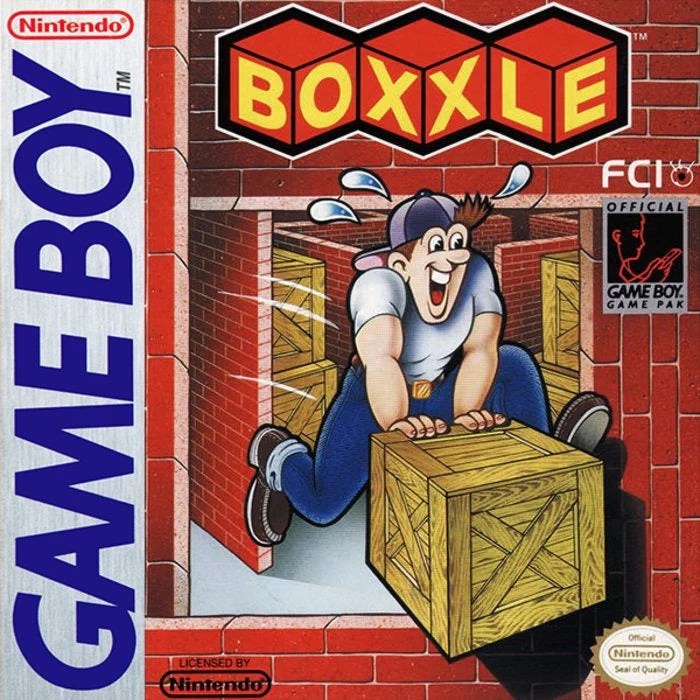
    Can we address the homunculus in the room first? I hate looking at the cover of Boxxle so much it’s unreal. No one has ever been so face-warpingly overjoyed to be pushing boxes. Blink twice if you’re being exploited, man!

    It is time to introduce The Sokoban Clause. The Game Boy’s library is chock full of these damn things, especially early in its life, and I have a horrible Sokoban allergy that’ll see me breaking out in hives if I play them for too long. That’s not to say I’m incapable of enjoying it or its offshoots (as we’ll see in later entries), but I generally prefer it as part of a larger design as opposed to pure unadulterated crate pushing. Going forward, massive Sokoban collections like this are going to necessitate some degree of level skippery, generally by way of passwords. I still intend to beat most of any given crate-shover for the purpose of thoroughness, but I can only shove so much crate before the splinters make it hard to type.

    And boy, Boxxle really offers nothing else to enjoy beyond manual labor. Aside from the cute little arcade game-esque interludes every 10 levels there are no ideas beyond “get back to work, asshole”. You don’t push different boxes. The levels are never anything but brick warehouses filled with wooden crates – the literal only thing that might surprise you is how the game zooms out to a smaller sprite set for big levels so you can still see the entire board. There are no obstacles beyond walls. It’s the same thing 108 times. The background music never even changes from the same 26 second loop! Yes it’s a whole 26 seconds, I counted. Because I had nothing else to think about.

    There are some considerations taken that make Boxxle marginally more tolerable than earlier Sokoban riffs. Restarts are quick. There is technically an undo button, though don’t give them too much credit as it only works for a single step. Anyone who’s played enough of these will tell you that you’re most likely to realize you botched your 100 step plan back at step 49 upon reaching step 78. Concluding our positives, there’s an incredibly crusty “YEAH” voice sample upon completion of each level that would make an excellent addition to any soundboard.

    You want proof that this game is too much of a bland thing? I used a YouTube playthrough to source my passwords because I don’t trust search engines or the internet at large anymore, and cheat sites were never reliable in the first place. After nearly passing out from exhaustion in world 5 I decided to skip a couple levels. Apparently the game’s fatiguing influence doesn’t just affect me, because after the post-world interlude the video includes 4 minutes of literally nothing. No menuing, no input, just a union-mandated 4 minutes of rest before mustering the spirit to continue on. The music kicks back in, the next level starts, and our hero just kind of sits there for a moment longer, contemplating quitting at the halfway point before eventually getting back to the grind. And despite that, this video is still the only valid speedrun I could find that wasn’t a TAS! Not even speedrunners want to touch this! Do you know how soul-sucking a game has to be to have a single run go unchallenged for nine years?

    This game’s credits end on the words “SEE YOU AGAIN” on an otherwise blank screen. I consider this to be a targeted threat, and if it wasn’t for this project I would be beyond excited to tell it no. Alas, Boxxle has a direct sequel and we are far, far away from escaping Sokoban’s gravitational pull on this system. Next time I talk about one of these it’ll be an example of how to do them right!

    1.5/5 vile demons in human guises sentenced to box pushing for their crimes

    one and a half boxxle faces
  • Pine Creek (2019)

    Pine Creek (2019)

    When I started covering indies in depth over at Pixel Die several years ago, horror was by far the most common genre on my beat. I eventually broadened my scope a bit but somehow never fatigued on it. My love of the genre is seemingly limitless, no matter how much schlock I consume! As a result the collision of my interests Pine Creek represents – modern indie horror and the Game Boy – couldn’t have been more up my street without setting up a gyro cart. Sadly, it was not to be. I gave Pine Creek every chance to impress me, and truly wanted to be, but I came away from it deeply disappointed in every regard.

    PC’s premise is traditional kids-on-bikes fare with just a bit of extra edge. The only universally loved member of your friend group has vanished. All that’s been left behind is some sort of ritual circle found in her bedroom, as well as a severed finger. This is a fantastic hook for a mystery! Supernatural and gruesome, you can practically imagine the back of the VHS sleeve. This is also where my praise ends.

    Mechanically, Pine Creek is a quest chain. Note that I didn’t describe it as an adventure game, or an investigation game, or even a point and click inventory management game. No: this is a single, somewhat lengthy quest chain that takes place over about 5 in-game days. Every single thing you do is either a fully optional side action that adds some color to the setting but otherwise achieves nothing (there are ending variations but no major divergences), or quest advancement spelled out on a provided to-do list. I wish I could tell you that advancing said quest is compelling, but it’s never any more complex than interacting with the right thing or person and having the game tell you what to do next. You quite literally spend most of this game running mundane errands, which is a stark contrast with the story as initially pitched!

    Then there’s the writing. To PC’s credit the game’s script initially features characters reacting in a variety of ways – paranoia, indiscriminate blame, confusion, indifference – but crucially, none of these are developed upon. I’m not interested in criticizing the quality of the translation or the juvenile sense of humor – the former is a consequence of this being an indie production, and the latter is excusable as our player character is a child – but the plot, themes, and treatment of its subject matter are poor across the board.

    PC wants to be about a lot of things: abuse of power, corruption, satanic panic used as a smokescreen for the previous two, and most significantly, child abuse. I commend the intent, but the execution sees these topics introduced as twists for shock value rather than developing them, never giving characters a chance to do anything more than make another clumsy quip that fits in a Game Boy text box before moving on to the next task. With one exception no character is ever meaningfully affected by what they experience. If PC is trying to emulate an exploitation-adjacent horror flick it whiffs on landing that tone entirely, and if it wants to be taken seriously it could have fooled me. From its inciting incident to its abrupt ending, this game is wholly unequipped to develop its ideas or grapple with its subject matter.

    It gives me no pleasure to summarily dismiss an indie game. I don’t doubt that Carmelo Electronics can take what they learned here and produce a stronger work in the future, but the game we have is difficult to recommend to anyone aside from the most insatiable horror hounds with outsized affection for this platform.

    1.5/5

  • My Descent into Marble Madness (1991, 1999)

    My Descent into Marble Madness (1991, 1999)

    Brother, I have seen some shit.

    There are a lot of folks who will tell you that a Marble Madness without a trackball is not worth playing. I disagree! Not enough to deny that the bigass spinny ball is obviously better, I’m not the kind of guy who buys Golden Tee home ports, but NES Marble Madness is a fine way to spend 5 minutes! One afternoon, and I honestly could not tell you why, I was struck with the urge to play some proto-Monkey Ball and popped the GBC game on.

    I wish I’d waited until this project had fully burnt off my novelty synapses first.

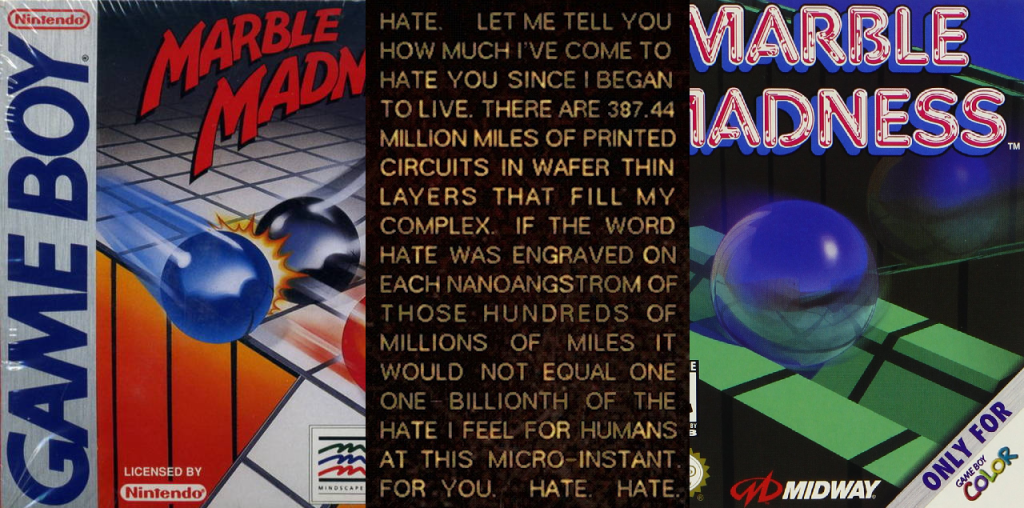
    Marble Madness GBC (1999)

    Woah, what the fuck? Why is it like this? Home computer joysticky versions worked fine in the 80s, as did NES MM in ’89 despite the dpad. Why in the year of our lord 1999, when portable video gaming technology was advancing at an unprecedented rate, did Digital Eclipse release a version of a then-fifteen year old game that works this poorly?

    GBC Marble Madness looks fine visually, but not to the point where it justifies this performance. This game chugs like a frat pledge that just lost his girlfriend and controls like a frat pledge that just got a new one. I thought things might be salvageable until level 3, then the faux 3D fully kicked in and my hopes were kicked in the marbles. I scooted the ball behind a wall and the game panicked like an anxious baby in a high stakes game of peekaboo, sprites flickering and frames dropping to single digits as it desperately tried to show me that there was in fact a marble on screen somewhere, somehow. It’s also a much twitchier game than other versions I’ve played, with the Marble having basically no weight, meaning you can fly off the stage far more easily and in sections that wouldn’t normally present a problem.

    If the only issues were iffy framerates and a subpar control scheme I’d still give this a begrudging pass based entirely on my preexisting biases, but no, it gets worse! The respawns are scuffed. I had several occasions where I made an oopsie and the game just dropped me into the same pit a few more times for good measure before finally allowing me to recover. If you know anything about Marble Madness, you know that means the run is basically over! You need to finish stages with as much time as possible and in better versions of the game there’s enough margin for error, but in this port? Nah. I never saw any of the magic wand time extensions in this version either, which is a bonkers omission.

    Getting through this was like pulling teeth: painful, repetitive, but not exactly the lengthiest torture. The last level is more a timer check and test of patience than anything else, and I suspect my first trip there was literally impossible, which isn’t great! Again though, this game takes 5 minutes to beat, retries are speedbumps. Eventually I ascended to top of the High Rollers board and switched the game off. I do not intend to defend my title.

    1.5/5


    I could have left it there. That should have been enough. Instead, this is where things went off the track. Out of truly morbid curiosity I figured hey, why not try the even older version while this one’s fresh in my mind and thumbs? The version without color from eight years prior! Maybe it runs a bit better, somehow? Maybe it isn’t missing entire gameplay elements? Maybe it won’t be the single worst game I’ve played for the website thus far?

    Marble Madness GB (1991)

    I did not know how good I had it. Jesus christ.

    Can I tell you how the sausage is made real quick? Despite my affection for the DMG I play all of these games on some kind of modernized hardware. Usually it’s the Analogue Pocket, sometimes it’s my backlit GBA. Both look pretty great, I’d say! They help smooth out the early Game Boy roughness a bit, especially the Analogue, and are easier on my aged eyes. My point is that I’m playing these games in much better conditions than any kid in ’91 would have been, and despite this playing Marble Madness for the Game Boy still felt like I was Sam Neill in Event Horizon.

    This abomination should not have been put on store shelves, full stop. You can’t fucking see anything, and it performs worse than the GBC version somehow! Every technical issue I called out previously is exacerbated, plus now the sprites clip and flicker in disorienting ways. I dare not even imagine how horribly this would have performed on the old pea soup screen, afflicted with ghosting and poor lighting. God, imagine giving this to a child to amuse themselves on a car trip! You would be entirely within your rights to call CPS, even if you’re currently in your 40s. Get a retroactive adoption. They owe you one.

    Game Boy Marble Madness is so horrid that I quit after a couple attempts and booted up the NES version, terrified that I had somehow brainwashed myself into long-term Marble Apologia. No! That port is still pretty good! The courses are far more navigable thanks to notably weightier marble physics, which allows for better turning without sacrificing speed. The clock is also a bit more forgiving on the home version. Once I recalibrated to playing a good video game for a change I was able to get through it just fine! Do you know how bad a game has to be to result in a sanity check long enough to clear a wholly different port?

    I don’t want to write about this any more than I have to. This is a truly odious piece of software, and its cartridges would be better served by having other games flashed onto them entirely at random. Congratulations on making the very bottom of The List, Mindscape! I can’t wait to play your Game Boy port of Klax, you hack frauds!

    1/5

  • Revenge of the ‘Gator (1989)

    Revenge of the ‘Gator (1989)

    This game represents so many firsts for this website. First HAL Laboratory entry of many! First pinball game, also of many! Not their first cart on the Game Boy though. I believe that’s Shanghai, which is straight up Mahjong solitaire with bangin’ tunes. We’ll get to that eventually, along with the ton of other tabletop adaptations that typified the early days of the DMG, but today is something a little bit faster! And also featuring tunes that bang!

    The first thing I did upon switching on Revenge of the Gator (or the far better Japanese title of The Great 66-Alligator Parade), besides watching the adorable gator dance number on the title screen, was tap A to launch the ball. It made its way up, stopped just shy of entering the table proper, and slid back down to the plunger so I could hold the button to give it the oomph it deserved. I immediately realized that even in ’89, HAL knew ball.

    RotG offers some incredibly smooth pinball on a speedy, gleefully impossible table. You can tell that HAL was excited by the concept of not having to replicate the limitations of a realistic pinball table because their first attempt resulted in a 4-tiered megastructure, with each tier having its own pair of flippers, as well as 3 bonus rooms that you effectively teleport to and from. Each section is displayed as its own screen – no scrolling, just switching upon leaving the current section – and you’d reasonably think that would be jarring, but it means you’re never missing the action or looking where you shouldn’t.

    Digital pinball is all about replicating feel. Convincing our lizard brain that we have in fact smacked a ball bearing is surprisingly difficult! Gator may have been made well before they started putting rumble paks in cartridges, but it still gets damn close thanks to its speed and deceptive generosity. The tips of your flippers are a tad further reaching than your eyes would have you believe and that little bit of extra control makes all the difference. The only area where RotG feels a bit weak compared to the real thing is in some of the fancier pinball maneuvers. Passes and juggles are tricky as you either smack the flipper at full force or not at all, and the ball is constantly jittering just a tiny bit to prevent getting stuck, but that’s a consequence of digital inputs and age more than anything else. Plus, the table is intentionally designed around you blasting your balls all over the walls.

    Of course you’re going to get robbed sometimes, that’s pinball baby! The bonus games are especially egregious in this regard, with #1 and 2 having a tendency to fire your ball in only to immediately hit a bumper and careen into the gutter. Hell, sometimes the ball saver doesn’t even do his job! The gator’s head is sloped and will occasionally just allow the ball to slide right off. Ask me how I know! Don’t trust that guy! He’s a little shit!

    Presentation-wise this game is charming from head to tail. From its Mambo #5-ass bassline with treble that only kicks in once the ball is in play, to the wacky point conditions involving feeding gators one moment and beaning them with the ball the next, to the gators themselves dancin’ and chompin’; every element of the production feels purpose built to put a smile on your face, so much so that it’s hard to muster any anger when it inevitably munches your digital quarter. None of that praise would save a bad pinball experience, but I think this is great! Arguably better than other pinball games that I’ve already played on the system that we’ll talk about another day! RotG has been my most pleasant surprise thus far and a heck of a debut for HAL on the list. There’s even a sick colorized romhack should you feel compelled to give it a go, and I’d highly recommend doing so.

    4/5

    – – –

    …hey, hey kid. You want a Protip?

    PROTIP: On the bottom-most section of the table, there’s a gator on the right side that’ll tail whip your ball if you shoot the gap next to it. Lift your flippers before it does so and instead of your ball arcing across the table, it’ll shoot up into the next tier every time. I’m no pinball wizard, but figuring that out sure made me feel like one.

  • Baseball (1989)

    Baseball (1989)

    My current play pile has been taking a bit longer to get through than anticipated, so this afternoon I figured hey, why not play a quick game of stickball? Hahahaha, “quick”.

    I feel like I should be more lenient with this cart. It was a launch title after all, even Nintendo didn’t really know what they were doing on the DMG yet, and its main draw was multiplayer which I have not touched. I know the history, I know the score, but…

    wow this is some awful baseball. This was a new experience for me, because I’ve never played by telegraph before!

    Look, I’m not a “sportsball” snob or whatever. I may be a nerd, but I’m the kind of nerd that participates in torpedo bat discourse, reminisces over the steroid era, and watches everything Ohtani does like a hawk. I like sports games! Especially baseball! This is a just a terrible baseball game!

    GB Baseball is agonizingly slow. Pitching, fielding, changing sides, almost every animation feels like it’s playing at 0.5 speed. Compared to NES baseball that’s honestly not too far from the truth! Watching fielders and runners alike trudge as the ball jutters across the sky frame by frame is excruciating, and you can barely see the field much less the ball if it gets some loft, so you’re forced to trudge players you can’t see towards a drop spot you don’t have. One of the benefits of digital ball is speeding the boring parts up, but this version feels like participating in a real life pickup game in the Ambien League.

    The one area that has some merit is the batting, which offers the bare minimum of acceptability. The camera swaps to behind the plate, you can reposition in the box, and the swing is pretty snappy. I ask for so little, and in this singular area Baseball manages to deliver, but surely we could have aimed a little bit higher?

    As bad of a time as I was having, I was willing to forgive a fair amount due to the age and legacy of this cart. Then I managed to smack a home run and all my good will vanished like an unsupervised box of Uncrustables in the dugout. The ball sloooooooowly drifted into the stands, a rectangle that said HOME RUN sleepily scooted its way from the bottom of the screen to the middle, and the scoreboard ticked up 1 by 1 to show the runs. Are you kidding me? Are you fucking kidding me? We don’t even get to see the runs??? It should be against the law to make a baseball game where sending one over the fence is this underwhelming! I did the fucking Thing, I demand satisfaction!

    I’m all for giving old games their due, and a lot of them are great, but the nicest thing I can say about Baseball is that I like its cover. Big Al wouldn’t tolerate such disrespect for dingers.

    1.5/5